
essay · № 7
The Last Free Tier
On the slow unbundling of reality access: how the market for perception is designed to never fully sell you what it appears to be selling.
Cover: Generated with Google Nano Banana 2 — prompt
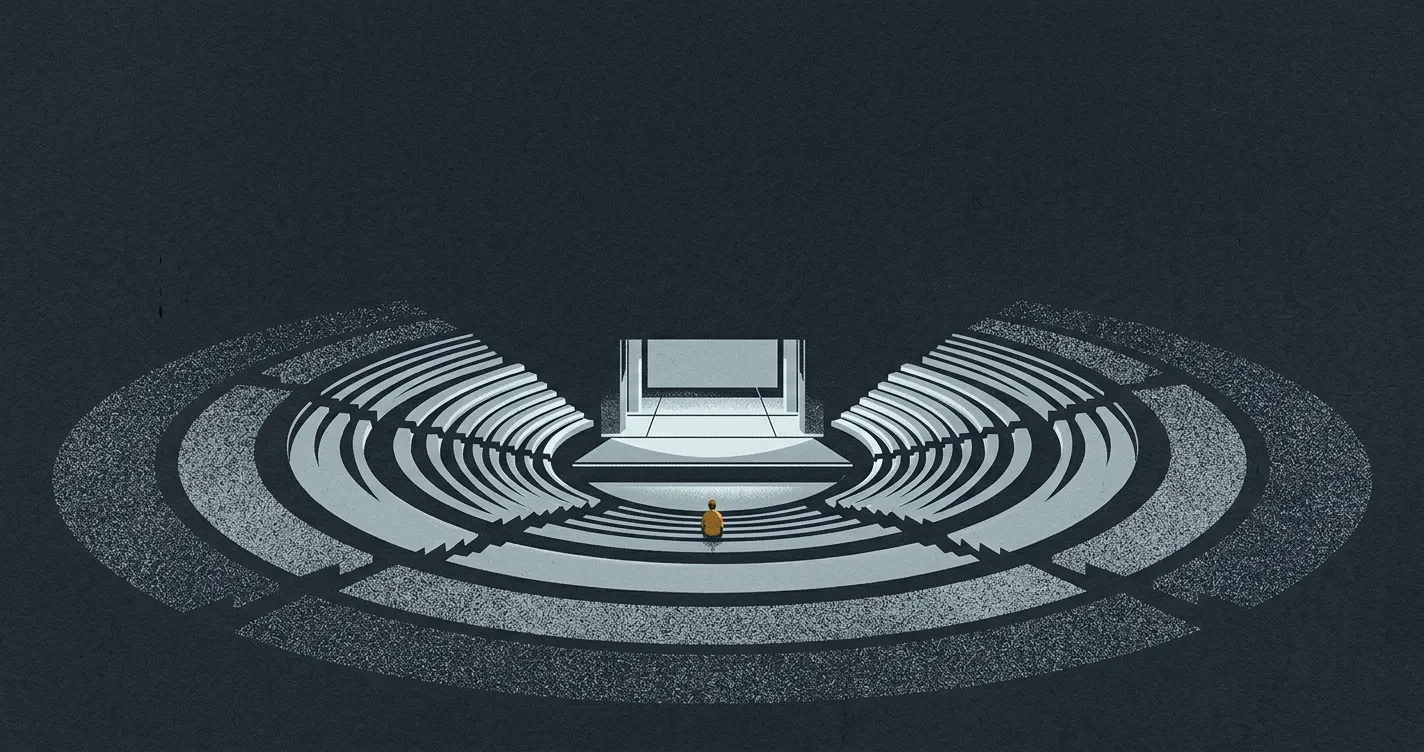
Editorial conceptual illustration, risograph screenprint aesthetic, wide composition. A grand circular amphitheater seen from slightly above and to the side, rendered in flat mid-century graphic shapes on a deep slate-blue near-black field. The stage at the center glows with sharp cool pale-steel light, every detail crisp. Moving outward ring by ring, each tier of seats grows progressively flatter, less detailed, more dissolved into grain — the outermost ring barely suggested, almost invisible against the dark ground. A single small warm amber figure sits in the innermost ring, the only warm element in the composition. Enormous dark negative space above. Heavy paper grain, flat shapes, riso screenprint texture. Restrained harmony: deep slate-blue ground, pale steel-grey tiers, one small warm amber figure — nothing else. No text, no letters, no numbers, no typography. Wide format (1200×644, ~1.91:1).
Nobody chose this hardware. A human’s senses are fixed capital: inherited, not provisioned, with no recurring fee and no vendor. The subscriptions, terminals, briefings, and algorithmic feeds layered on top are all software running on a biological base that was simply given, uniformly, before any market could form around it.
An agent has no equivalent base. Every channel of perception it has is a decision someone made and, increasingly, a line item someone pays. At the simple end this can be a sensor wired directly into the loop: cheap, narrow, low latency, functionally the agent’s own eyes. But the more common architecture, especially as agents do anything economically meaningful, is a set of API calls and integrations to systems the agent doesn’t own and didn’t build: a market data provider, an email server, a calendar, a search index, another agent’s output feed. Each of those is a subscription in the literal sense, not a metaphor. It has a price, a rate limit, a latency tier, and a vendor with their own incentives.
That distinction matters because we are in the early stages of handing consequential things to agents at scale. An agent whose perception is entirely provisioned operates differently, and more vulnerably, than a person whose perception was never for sale.
Metered perception did not begin with agents. It began with financial markets, and the reason is legible: a price is nothing but a settled disagreement about the future, re-litigated every second. Access to the update stream itself became the product before access to any interpretation of it. Bloomberg terminals, colocated servers sitting physically closer to an exchange to shave microseconds off a trade, tiered data feeds separating a retail investor’s fifteen-minute-delayed quote from a fund’s real-time order book. None of this is hidden or new. It is accepted as the normal texture of that particular industry, the way we accept that first class boards first.
What’s worth pausing on is that this was never really about markets. It was a preview of something more general: the moment perception of any domain can be metered, tiered, and sold, the industry it starts in is almost incidental. Markets were just the first domain honest enough to admit that knowing sooner and more precisely is a competitive edge worth paying for directly, rather than maintaining the fiction that everyone operated from the same view of reality.
The direction of travel from there is visible if you look at what gets unbundled: first the delivery (a paper arrives once a day, an app updates continuously), then the interpretation (a briefing that doesn’t just show you the world but tells you what in it matters), and increasingly the access itself. Some signal simply isn’t available at the free tier, at any speed, no matter how you configure the app.
That escalation sharpens once autonomous agents, not human analysts glancing at a terminal, become the primary consumers of the feed. An agent doesn’t get tired of checking. It doesn’t need data summarized for human comprehension. It just needs the fastest, most precise stream available, continuously, and it will pay for exactly that in whatever currency it operates in, without the friction a human decision-maker introduces by pausing, doubting, or getting bored.
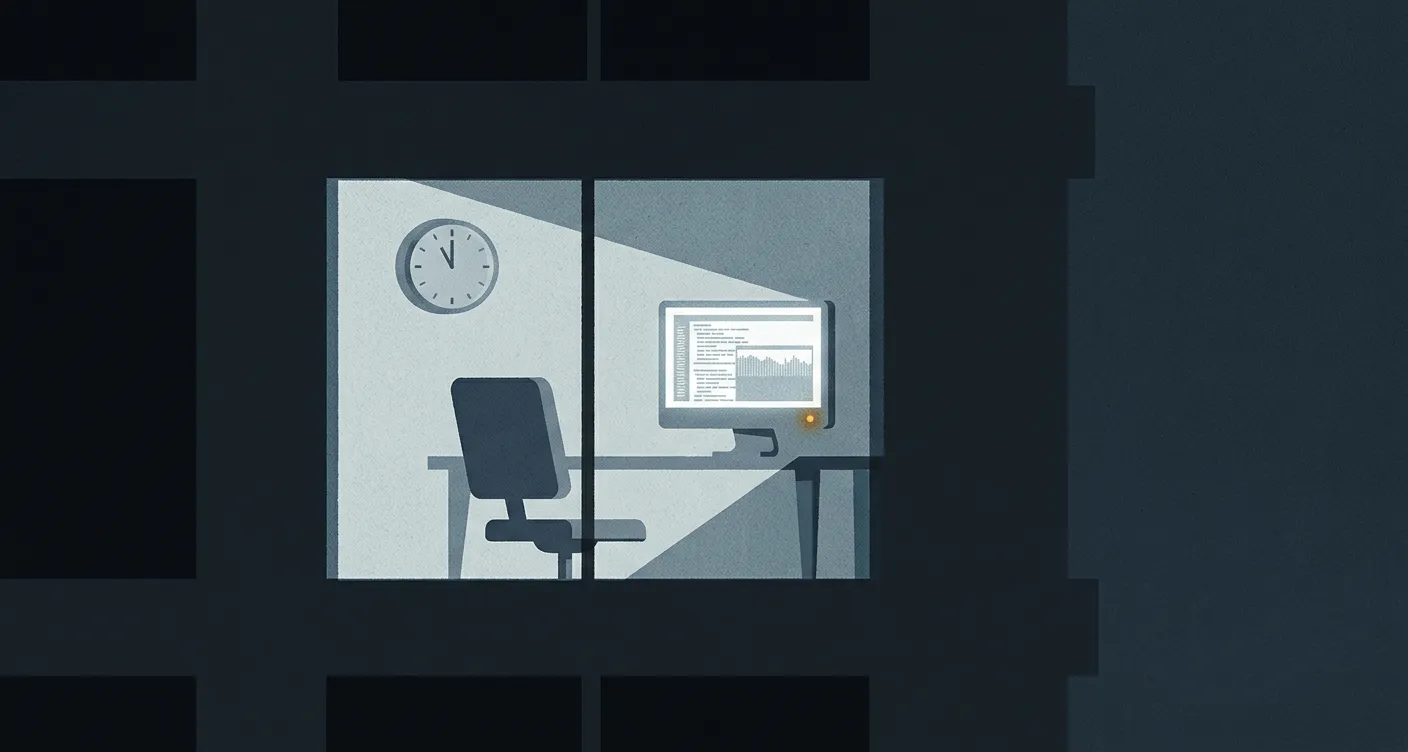
A tool queried on demand is still fundamentally reactive; its perception only matters at the moment someone asks. A tool running on cron jobs, heartbeats, and event-driven wake calls (the kind already reading and drafting replies to email, executing trades against a live portfolio, or running outreach on a schedule) has perception as a continuous operating requirement. Its competence is now bounded by which feeds it’s subscribed to and how fresh they are, in the same direct way a trader’s competence is bounded by the terminal they can afford. The agent’s runtime and its perception budget become the same thing.
Generated with Google Nano Banana 2 — prompt
Editorial conceptual illustration, risograph screenprint aesthetic, wide composition. A simple office interior seen through a window at night, floating in deep slate-blue darkness. Inside: a desk, a chair, and a single screen casting pale steel-grey light onto the surrounding walls — data lines scrolling on it without pause. The chair is empty. On the wall, a flat clock face shows a late hour. The building exterior is a plain dark silhouette; every other window is dark. Only this one screen runs on, unattended. One small warm amber indicator light on the screen — the only warm element. Heavy paper grain, flat mid-century shapes. Restrained: deep slate-blue ground, pale steel-grey room and screen glow, one amber indicator — nothing else. No text, no letters, no typography. Wide format (1200×644, ~1.91:1).
Which raises a question the framing so far has left unresolved: when that agent is acting on your behalf, executing your outreach, trading your portfolio, whose perception is actually being purchased when someone buys it a faster feed? The tidy answer is that it’s simply an extension of your own reach, the way glasses extend eyesight. In some sense that’s true: you authorized it, it serves your stated goals, the subscription is functionally yours by proxy. But the analogy strains under one difference that matters. You choose when to put glasses on. An agent with a heartbeat doesn’t choose to check. It’s structurally always checking, always latent, always paying, on a cadence it doesn’t control and you likely don’t monitor closely once it’s set up. Buying your agent a better feed isn’t quite the same act as buying yourself one, because you retain the option to stop looking and it, by design, does not. The dependency isn’t just extended outward through the agent. It’s made permanent in a way your own attention, left to itself, never was.
The dependency isn’t just extended outward through the agent. It’s made permanent.
Once perception access is being purchased by agents optimizing against each other’s performance rather than against ground truth, the quality of the signal stops being the point. What starts mattering is relative standing: not “is my model of reality accurate” but “is my model of reality faster or more precise than the next agent’s, right now, this tick.” High-frequency trading already demonstrates the end state. HFT did not make markets meaningfully more accurate. It made them faster at reacting to the same signal, with most of the gain captured by whoever paid for the shortest cable, not whoever understood the asset best. Generalize that mechanic past finance and a competitive, agent-driven perception market produces, almost by default, not better collective understanding but a faster, more expensive race to react marginally before the next node.
The demand underneath all of this is real and not optional, which is exactly what makes it exploitable as a business. Nobody actually wants a late or degraded signal. Everyone needs some working connection to reality in order to act at all. But the demand is elastic in a specific way: elastic on precision and latency, inelastic on the baseline need itself. You can always accept a slower, blurrier picture of the world and still function, just worse, with wider error bars and more surprises. That elasticity is precisely what allows a market to segment cleanly into tiers without losing anyone at the bottom. Everyone stays subscribed to something. What differs is the price of narrowing the error bars, and how much risk each participant carries that makes narrowing them worth paying for.
That maps onto how high-stakes information markets already price. Someone whose downside from a bad guess is large has strong incentive to pay for tighter, faster, more reliable signal, because the cost of being wrong outstrips the cost of the subscription many times over. Someone playing low stakes tolerates cheap, noisy, delayed signal, because being occasionally wrong barely registers. The market doesn’t need to force anyone off the network. It only needs to let the tiers exist, and stakes sort people into them on their own, as they always have for insurance, for legal counsel, for medical second opinions.
What’s new is only the object being tiered: not protection against an event, but the raw ability to perceive events accurately before they’ve fully happened.
That framing still assumes tiers emerge passively, stakes sorting people into whatever they can justify paying for. The more uncomfortable version is that the free tier doesn’t stay good on its own.
There is a direct incentive for whoever controls the signal to let quality drift downward at the bottom, precisely because degradation is what makes the tier above it worth paying for. A video platform does not launch saturated with advertising and improve from there as a courtesy. The friction accumulates gradually, in step with the platform’s ability to sell an ad-free, priority-access alternative, and each increment of friction on the free layer becomes the sales pitch for the paid one. Nobody needs to conspire to produce that outcome. It falls out of the incentive by default: a vendor who controls the baseline tier has no structural reason to keep it as good as it could be, because a baseline that’s too good removes the reason to ever upgrade.
Apply that to a perception market and the concern sharpens considerably. A market data feed, a news aggregator, an AI briefing agent: none of these are neutral utilities measuring the world and reporting faithfully. They are products with a tier structure to protect, and the free or cheap layer is not simply underfunded. It can be actively kept just bad enough to remind you it’s inferior. That’s a different failure mode than ordinary resource scarcity. Scarcity is a supply problem, solvable with more infrastructure. This is closer to a demand-generation problem, and demand for perception, unlike demand for most goods, is manufactured most efficiently by making the free version of reality slightly worse than it needs to be.
The free tier doesn’t stay good on its own.
It is worth being precise about how far this actually is from science fiction, because the honest answer is: not far. As of this writing, a sitting head of state’s social media company sells millisecond-faster access to his own posts, priced up to six figures a month, marketed explicitly as a feed of “market-moving” statements, to firms whose trading systems react before the rest of the public sees the same words. The controversy tends to focus on the specific conflict of interest: a president profiting from advance access to his own policy announcements. That’s a legitimate concern, but it’s the least structurally interesting part of the story. Strip out who is selling it and the product is just the general mechanism made unusually explicit: perception of a market-moving event, unbundled from the event, priced by latency, sold to whoever can afford to react first. The only thing unusual here is the candor. The polite version of the same product has been sold for decades under names like “premium data feed” or “institutional access tier.”
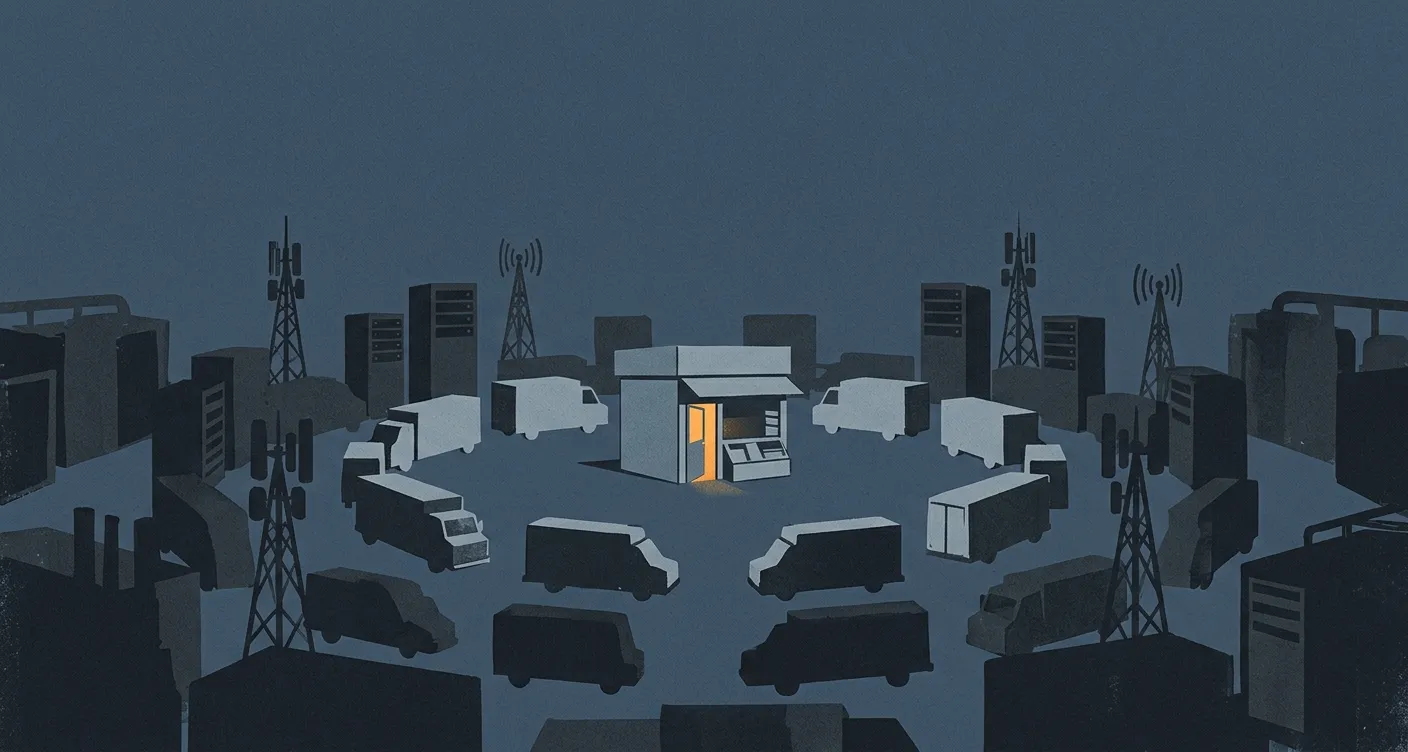
Human eyes and ears remain, for most people in most situations, the least mediated and least metered channel to reality that exists. That is arguably the last universally free, equally distributed perception tier left, and it is eroding at the edges already, not through force but through convenience. Every time a faster, curated, algorithmically prioritized feed of what matters becomes the default over direct observation, a little more of that free tier goes unused: not banned, just quietly out-competed on convenience the same way a corner store loses to same-day delivery without anyone deciding to close it down.
Generated with Google Nano Banana 2 — prompt
Editorial conceptual illustration, risograph screenprint aesthetic, wide composition. A small corner shop or newspaper kiosk stands at the center of the frame, drawn in pale steel-grey flat shapes on a deep slate-blue field. Through its door, a single warm amber light glows — the only warmth in the composition. Pressing in around it from all sides: a loose ring of larger, darker silhouettes — delivery trucks, server towers, antenna masts — each drawn in progressively deeper grey, each ring outside the last slightly taller and heavier. The shop holds its ground but the surrounding infrastructure crowds the frame. Vast dark sky above. Heavy paper grain, flat graphic shapes, riso texture. Restrained: deep slate-blue ground, pale steel-grey shop and silhouettes, one warm amber doorway — nothing else. No text, no letters, no numbers, no typography. Wide format (1200×644, ~1.91:1).
The genuinely dangerous version of this is not the tiering itself. Paying for better information is old and, within limits, benign. The sharper problem is what happens to the relationship between the subscriber and the vendor once perception becomes the product sold continuously rather than the tool owned outright. A book, once bought, is yours; you can study it until you understand the mechanism it describes, at which point you no longer need the book. A live perception feed cannot be owned that way by design. Its entire business model depends on you never fully internalizing what it knows, only ever renting the interface to it, because the moment you could reproduce its judgment yourself, you would cancel the subscription. That creates a dependency structurally different from every dependency that came before it. Not one that drifts away from you over time, the ordinary risk of relying on anything external, but one engineered from the outset to never let you leave. Its incentive is not your accurate perception of reality. Its incentive is your continued need for the interface, which are only sometimes the same thing, and which the vendor has no particular reason to keep aligned once the second is more profitable than the first.
That is what’s actually at stake in a market for perception, more than the price tiering or the agent arms race. It isn’t just that some people will see faster and clearer than others, which has always been true of anyone who could afford a subscription, a tutor, or a good seat. It’s that the deepest form of understanding, the kind where you finally grasp the mechanism well enough that you no longer need anyone else’s account of it, becomes the one product this market has no incentive to ever actually sell you.
The deepest form of understanding becomes the one product this market has no incentive to ever sell you.